Showing posts with label weaving drafts. Show all posts

Friday, August 27, 2021

Using WeavePoint to design an amalgamation draft

 I've been fascinated with amalgamation drafts since I first read Alice Schlein's Network Drafting: An Introduction.  Recently, Alice published a new monograph  called Amalgamation: Double your Dobby and I eagerly purchased a copy directly from her.

As I read the monograph, it appeared that only some weaving software programs were capable of copying the drawdown portion of the draft and pasting it into the threading.  I use WeavePoint for most of my design work, so I went to AVL to see if the programmer of WeavePoint, Bjorn Myhre could help.   At the same time, Bob Kruger from AVL sent the question to Jannie Taylor.  Between the two responses from Bjorn and Jannie, I was able to amalgamate to my heart's content!  So - thanks to both of them for making my software just a bit more valuable to me.

The following is my process.  I've also tried it with Fiberworks for PC and it works well there too.  Choose a threading that you want to amalgamate.  You will notice that I have selected a threading that can be duplicated, in other words, I haven't ended on shaft one so that it repeats without double threads.  Alice's method is just a bit different and she does put in threadings that begin and end on the same shaft.  (More about that later).


The next step will be to add a satin tie up and select "tromp as writ" to fill in the treadling.  In the example below the counter is 11.  (Satin counters are explained in Alice's monograph which I recommend buying if you are interested in doing this kind of design work.)  A plus to WeavePoint software is that you select Fill from your options bar - then select satin.  This feature will give you all the counters that will work with the number of shafts in your design.  Otherwise you will need to research satins for the number of shafts you are working with.

Then, change from tie up mode to liftplan mode.  This will give you a liftplan that you can paste into your threading.  So - copy the liftplan and paste it into the threading to the left of the original 


Change back to a tie up and treadling and do another "tromp as writ". 

 
Now you are ready to get rid of the satin tie up and experiment with twill tie ups.  Check the float length when you have one that pleases you.  Sometimes it can be hard to get something that has  floats that are 5 or less in length.  WeavePoint makes searching for a tie up easy too.  In the Fill option, select twill tie ups.  You will be able to set the float length for the tie up.  I usually start with 3, sometimes need to go down to 2 in order to find a tie up that won't result in too long floats in the drawdown.


You can use the draft as is now, or do another little fiddle bit.  I often copy the entire threading and then use "paste special" which is found in the Edit menu.  Click on "flip vertical" and then paste that threading to the left of the original threading.  This option gives you more designs.


The final bit of information that I gleaned while working with Alice's monograph and my WeavePoint design solution is that when you copy the original liftplan with the amalgamation in it, you can paste it into the threading by doing  a vertical flip (again use paste special in the Edit menu)  This allows you to start and end on the same shaft with your original threading.
 
3/18/23  This is a postscript to this post.  I recently found that Handweaving.net has a feature that automatically will make a series of amalgamation drafts online.  Watch the tutorial https://www.youtube.com/watch?v=P4cysOpJSKk   and see what you think.  You can always upload one of your own drafts to the site and manipulate it online as well.  Amazing tools that make our weaving design life so much better.


Monday, March 28, 2016

Obsession with Braided Twills

In a weaving group that I belong to, one of our members brought a braided twill scarf for show and tell. Warp and weft were the same color, so the design was subtle, but very beautiful.  It started me on a search for simple braided twills that could be woven on four or eight shafts.  I have found a few and will add to this collection as I find more.
Here's a lovely four shaft version
I found this one in Carol Strickler's book of 8 shaft drafts #355

 
This one, or something very similar also appears in Carol's book, but it is part of a gamp.  Here it is using 10 treadles.


This draft is quite lovely and again only uses 10 treadles.


The advantage to this draft is that it is on a straight draw threading and straight treadling. I tried a treadling advance of four with this tie up which is shown below.


Unfortunately, this increased the float length to 6 in the warp direction.  Still, it might be nice in fine threads.
 
I found this lovely braided twill in Oelsner's book and have added it to the collection here. 
 

Monday, December 19, 2011

Everything But the Kitchen Sink Towels

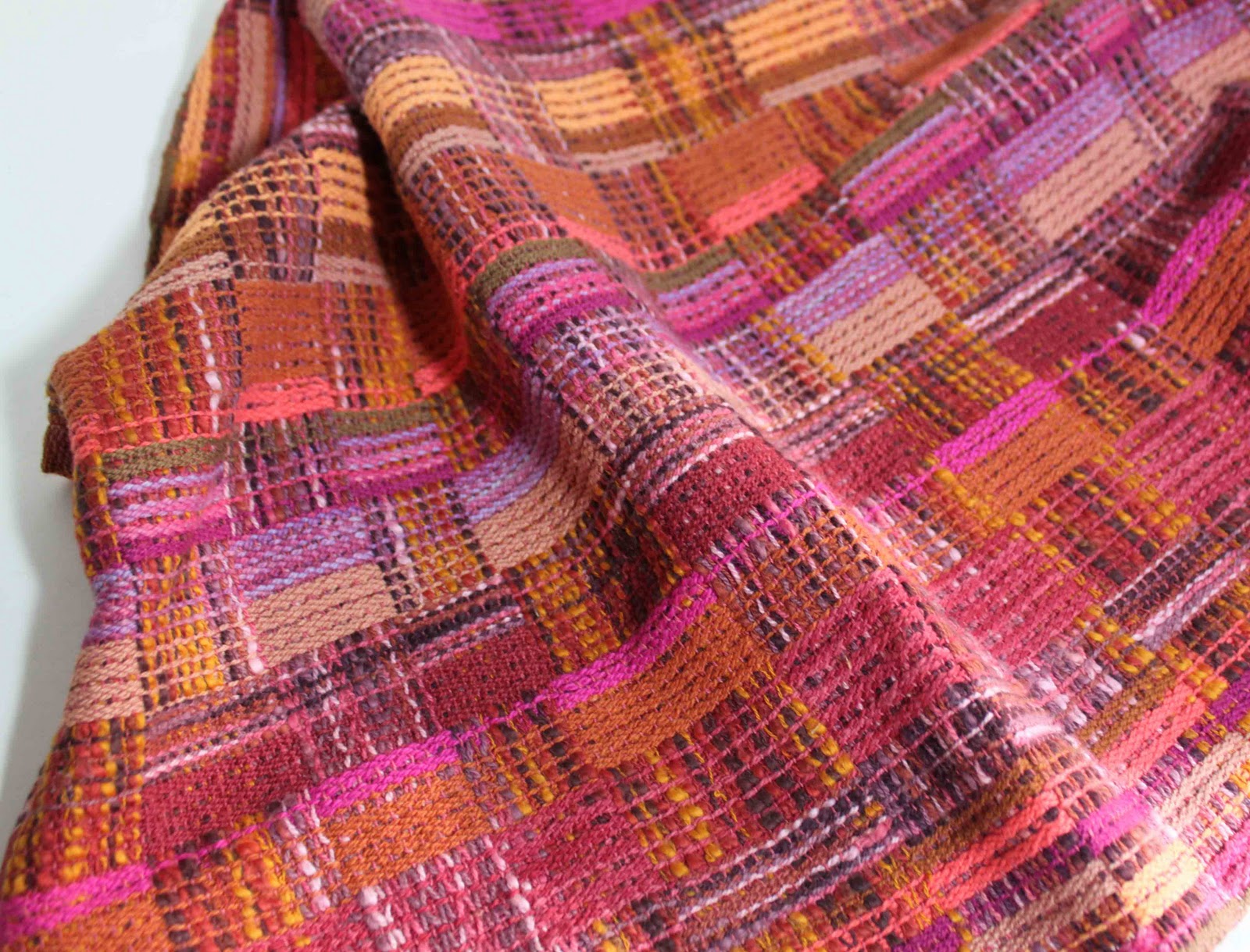
Did you check out the halvdräll runner in the Nov/Dec 2011 issue of Handwoven?  I've been eyeing the structure for several years after I received a sample in a Complex Weavers exchange several years ago. After I read the article in Handwoven, I decided to try it out, but with a twist or two.  I have lots of little balls of yarn left over from bobbins (I save everything) and cones of yarn with just a bit on them.  I collected oranges, browns, pinks and a few lavenders for warp yarns and set to work to wind a multi - multi color warp.  It took a bit of planning because the halvdräll threading blocks vary between 9 and 10 threads, so I did a whole thread by thread drawdown and expanded the four shaft draft to eight so that I wouldn't have to reload heddles on the first four shafts of my Baby Wolf.

Once I had gotten the warp on the loom and started weaving, I decided that some of my variegated yarns would be terrific thicker wefts - with so many colors in the warp it made them busier and better (IMHO).  I also pulled out my box of little balls of cotton yarn and started using them up, ball by ball.  The weave structure uses a tabby weft in a finer grist followed by a pattern weft with heavier yarns and I found I could use most medium value colors because there were so many colors already present in the warp.


7/23 Here is an addendum to this post.  The original Handwoven magazine had an error in the threading of the draft on the first page  Obviously it worked, because I used it.  An errata post was made later in the magazine and here is a link to the correct wif file.  https://handwovenmagazine.com/library/55988020

One thing  I found after I had threaded my loom was that I needed a straight draw threading at the beginning and the end of the warp so that the pattern wefts looked good at the selvedges and also so that I could do plain weave hems.

While throwing everything into these towels possible, I ran across a very good cookie recipe with the same name - not halvdräll, but Everything But the Kitchen Sink Cookies from Martha StewartTry them, I think you will find they are as tasty as the towels are colorful.

Here is a P.S. to the post.  A weaving friend asked Madelyn van der Hoogt what the meaning of halvdräll was.  Here is her answer

I'm going to tell you this off the top of my head, but I’m pretty sure it captures the gist. Shaft movement in Swedish counterbalance looms is operated by pulleys called dräll pulleys. In some weaves, such as damask and turned twill, all of the shafts in the pulleys operate against each other (I’m not saying this right. Maybe it’s better to say that each block has its own separate shafts, so when you change from one block to the next, you change the operation of both groups of shafts on the pulleys). These are dräll weaves. In halb dräll weaves, the pattern shafts for each block are different, but the tie-down shafts are the same for both blocks. This affects the way the pulley system works; only “half” change their operation from block to block, hence halb dräll.

So, turned twill is a dräll weave. Summer and winter is a halb dräll weave.
Madelyn