Showing posts with label block weaves. Show all posts

Wednesday, March 1, 2023

Designing with Blocks Using Mathematical Sequences

Using mathematics to design weaving profiles or sequences is a theme that I return to over and over.  I have relied on writings about this subject because my mathematical knowledge is relatively rudimentary.  I was very lucky to have found this document in the Ralph Griswold collection of weaving documents stored at the University of Arizona website.  "Algebraic Expression in Handwoven Textiles" by Ada K. Dietz  

This is my journey into designing a profile and weaving drafts based on the mathematical expression of the cube of a binomial  (a + b) ³  My interpretation of this expression is aaa + aabaabaab + abbabbabb + bbb. I regrouped this into aaaaa b aa b aa b a bb a bb a bbbbb  Below is the two block profile created from my interpretation.
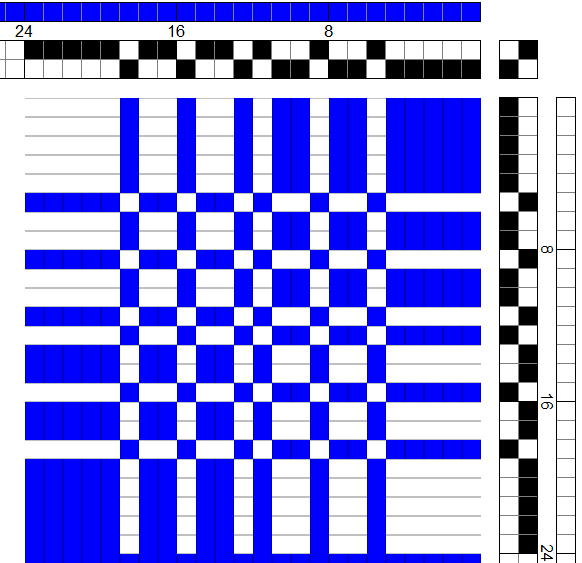
 

The next steps are to convert this into weaving draft using block substitution. With four thread blocks, the draft uses 8 shafts. With 5 thread blocks, the draft uses 10 shafts - and so forth. The most common substitutions are with 3/1 and 1/3 twill blocks, but I’ve found that more interesting designs can be had
when you think outside the box. 
The following draft interprets the profile using 3/1 and 1/3 twills. But  this tie up could be altered in one or two quadrants to a broken, 4 thread twill. What fun that might be.
 

 The block conversion below uses a 3/2 twill and an altered 5 thread twill, (which doesn’t have a regular twill line). See the little squares in the design where the altered twill is weaving in block B

This conversion uses a regular 5 thread satin and an altered satin tie up


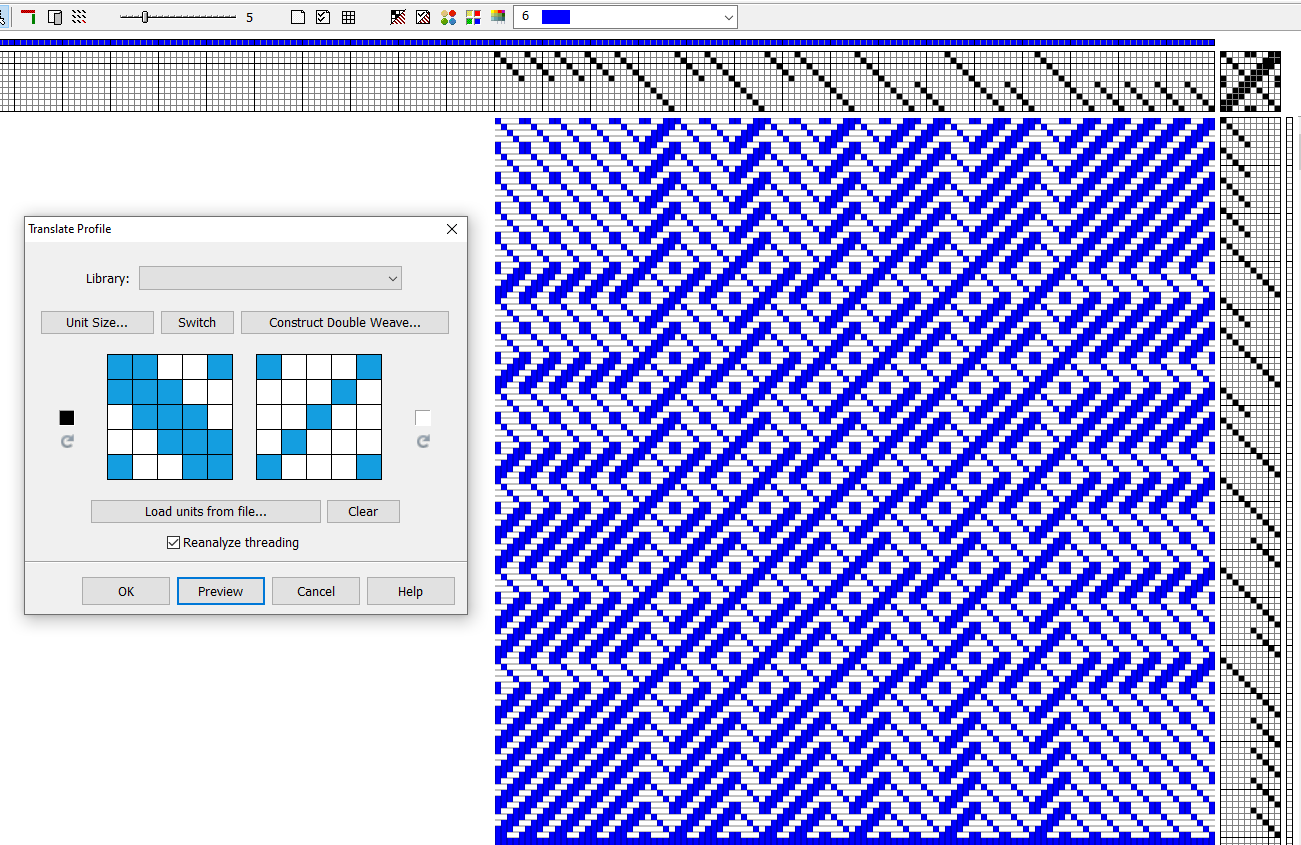
The following draft uses two altered 5 thread twill blocks. I discovered this option in Handweaving.net. To me, the lines look wavey. The surprise is that my weaving software (WeavePoint) analyzed the threading and found it could be woven on 8 shafts.  In checking further, I also found that Handweaving.net will compact this draft to 8 shafts as well. How great is that!


Below Block A uses an altered satin tie up and Block B uses a 5 thread altered twill tie up. Busy, but the profile is still visible.


The next draft uses 5 thread satin blocks. The dark block is flipped horizontally and reversed so that dark now becomes light. The draft doesn’t have clean cut edges where the two blocks meet.

There are, of course, many more options to interpret this profile.  Feel free to experiment and enjoy the results!

Wednesday, October 8, 2014

Turning a Two Block Profile into Turned Taqueté (4 Shafts)

My guild (Reno Fiber Guild) is having a year long study of profile drafts and block weaves.  We kicked the subject off at our October meeting and broke into a variety of groups that will study specific block weave structures ending in April with weaving off designs on a variety of four and eight shaft looms.  Several guild members had woven four shaft turned taqueté and wanted to do more in the way of designing using that structure.  I could certainly convert a profile to taqueté and then turn the draft, but decided that it should be feasible to convert a profile to turned taqueté without going through the intermediary step.

I started with the weaving software, WeavePoint, converting profiles to taqueté, turning the drafts and analyzing the results.  I had in mind presenting something similar to Madelyn van der Hooght's diagrams that have a numerical threading, tie up configurations and treadling sequences for various block weave structures.  What I found is that once you have gone past a two block profile and given that you are turning the draft, things aren't so straight forward as they are when you are designing with taqueté.   What follows is what I have learned so far.

One of the interesting things about taqueté and its turned version is that without alternating colors (in the weft for taqueté or in the warp for turned taqueté) the draft in two colors has no apparent design.  Once you put in the alternating color sequence, the block pattern magically appears.

Along my journey, I found a couple of ways to thread the four shaft  version of turned taqueté (aka warp-faced compound tabby).  I thought I would present both of them because I can see advantages to both.

Here goes.  If you use two colors in the warp and alternate them all across the warp the threading is as follows                         

                                           Block A 1-2-3-4 
                                           Block B 2-1-4-3
                                          
If you change the color sequence at every block change you can thread
                                          Blocks A & B 1-2-3-4
                                           
The secret is that you must change the color sequence at the beginning of a new block. In other words if you have been threading red -blue,  at the beginning of a new block you will thread blue - red,until you reach the end of that block and switch back to red- blue.

Now for the Tie Up and treadling.  Since we are only dealing with two blocks and with four shafts, we must alternate the two blocks in a profile draft and the tie up that works is this.


The treadling for Block A is 1-3-2-3 and the treadling for Block B is 1-4-2-4.  That's all there is to it.
 
 
Here are two drawdowns using first  a two block threading sequence and the second using only color change on a straight draw threading to delineate the blocks.


Block A threaded 1-2-3-4 and Block B threaded 2-1-4-3

 
straight draw threading, but duplicate color sequence at block change in warp


The next post is changing a four block profile draft into an eight shaft draft of turned taqueté.  Hint - not all four block drafts will reduce to an eight shaft draft.  It will depend on the number of treadles you need to use because, remember, this is a turned draft.
 
Note:  One of the nicest things about blog posts is that they can be amended and updated.  After I had researched and written this post, I came upon an interesting article in Weaver's Magazine Issue 12.  The article was written by Betsy Blumenthal and it was entitled "One-Shuttle Wonderful".  This article describes the color sequence changes in the warp to get the double face cloth and the structure was called "warp-faced compound tabby.  There is simply nothing new under the weaving sun!