Showing posts with label profile drafts. Show all posts

Wednesday, March 1, 2023

Designing with Blocks Using Mathematical Sequences

Using mathematics to design weaving profiles or sequences is a theme that I return to over and over.  I have relied on writings about this subject because my mathematical knowledge is relatively rudimentary.  I was very lucky to have found this document in the Ralph Griswold collection of weaving documents stored at the University of Arizona website.  "Algebraic Expression in Handwoven Textiles" by Ada K. Dietz  

This is my journey into designing a profile and weaving drafts based on the mathematical expression of the cube of a binomial  (a + b) ³  My interpretation of this expression is aaa + aabaabaab + abbabbabb + bbb. I regrouped this into aaaaa b aa b aa b a bb a bb a bbbbb  Below is the two block profile created from my interpretation.
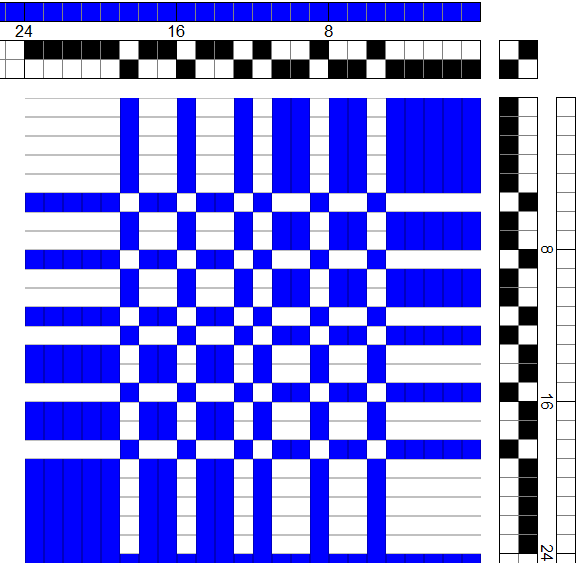
 

The next steps are to convert this into weaving draft using block substitution. With four thread blocks, the draft uses 8 shafts. With 5 thread blocks, the draft uses 10 shafts - and so forth. The most common substitutions are with 3/1 and 1/3 twill blocks, but I’ve found that more interesting designs can be had
when you think outside the box. 
The following draft interprets the profile using 3/1 and 1/3 twills. But  this tie up could be altered in one or two quadrants to a broken, 4 thread twill. What fun that might be.
 

 The block conversion below uses a 3/2 twill and an altered 5 thread twill, (which doesn’t have a regular twill line). See the little squares in the design where the altered twill is weaving in block B

This conversion uses a regular 5 thread satin and an altered satin tie up


The following draft uses two altered 5 thread twill blocks. I discovered this option in Handweaving.net. To me, the lines look wavey. The surprise is that my weaving software (WeavePoint) analyzed the threading and found it could be woven on 8 shafts.  In checking further, I also found that Handweaving.net will compact this draft to 8 shafts as well. How great is that!


Below Block A uses an altered satin tie up and Block B uses a 5 thread altered twill tie up. Busy, but the profile is still visible.


The next draft uses 5 thread satin blocks. The dark block is flipped horizontally and reversed so that dark now becomes light. The draft doesn’t have clean cut edges where the two blocks meet.

There are, of course, many more options to interpret this profile.  Feel free to experiment and enjoy the results!

Saturday, June 12, 2010

It's a Lace Love Affair

I belong to several Complex Weavers study groups and one of my favorites is the Early Weaving Books and Manuscripts .  The leader of the group is Marjie Thompson who is a powerhouse of knowledge about old weaving draft books from the past.  Each year, some of us in the group participate in a sample exchange in which we use a weaving draft from a book or manuscript that is at least 100 years old.  This is a mighty sample exchange, because you weave 52 samples and get back 50 and they range from 2 shafts up to 40 (I haven't seen any jacquard woven samples yet). 

In a past exchange and also in another CW group called the Computer Aided Design Exchange, Laurie Autio has written extensively about lace drafts (her particular specialty).  I have not done a lot of lace weaving, but having figured out that I could use almost any draft as a profile for lace, I decided to weave my EWBM samples in lace this year.

I almost always use the Handweaving net  for my sample source.  First off, most of the books represented there are at least 100 years old.  And secondly, there are so many draft choices that there is always something interesting to try.  The drafts of Christian Morath are a treasure and there are an abundance of 16 shaft tie ups that would be problematic because of long floats if you wove them thread by thread. If you use them as profile drafts they work beautifully.  I found several tie ups that I liked and coverted them to a lace threading and treadling.  And then, of course, I lost track of where I found the particular draft I used for my samples.  This is a big no no for the sample exchange which wants to know where you got your draft.  I had to explain the error of my ways on my draft sheet because by the time I realized I didn't have a source reference, the sample cloth had been woven and cut off the loom.

The good news is that I really love the woven cloth.  The warp is unmercerized 16/2 cotton sett at 24 epi.  The sett was a bit loose, but I wanted the lace floats to be able to move around and settle in the finishing process.  The warp measured 21" in the reed and 17" after wet finishing.  Wow - what a lot of shrinkage. I wove another 5 towels after my samples were completed, using several different weft colors and a different tie up for each towel.  I'm hooked on lace and I'll be weaving more in the future with more interesting profiles.

Last evening I received some of the samples from this year's exchange and they are wonderful.  Mine are still sitting on the dining room table, waiting for more fray check finishing. But, I'll get them in the mail soon and finish my obligation for the year.  Thank goodness for all the weavers who participate in this exchange.  It gives us food for thought and a wealth of ideas for future weaving projects.